
Hue Royal Tombs: Khai Dinh, Minh Mang or Tu Duc?
Hue's Nguyen kings built their tombs in the hills along the Perfume River. How Khai Dinh, Minh Mang and Tu Duc differ, which day tours visit them, and tips for your visit.
By AmGo Travel6 min read
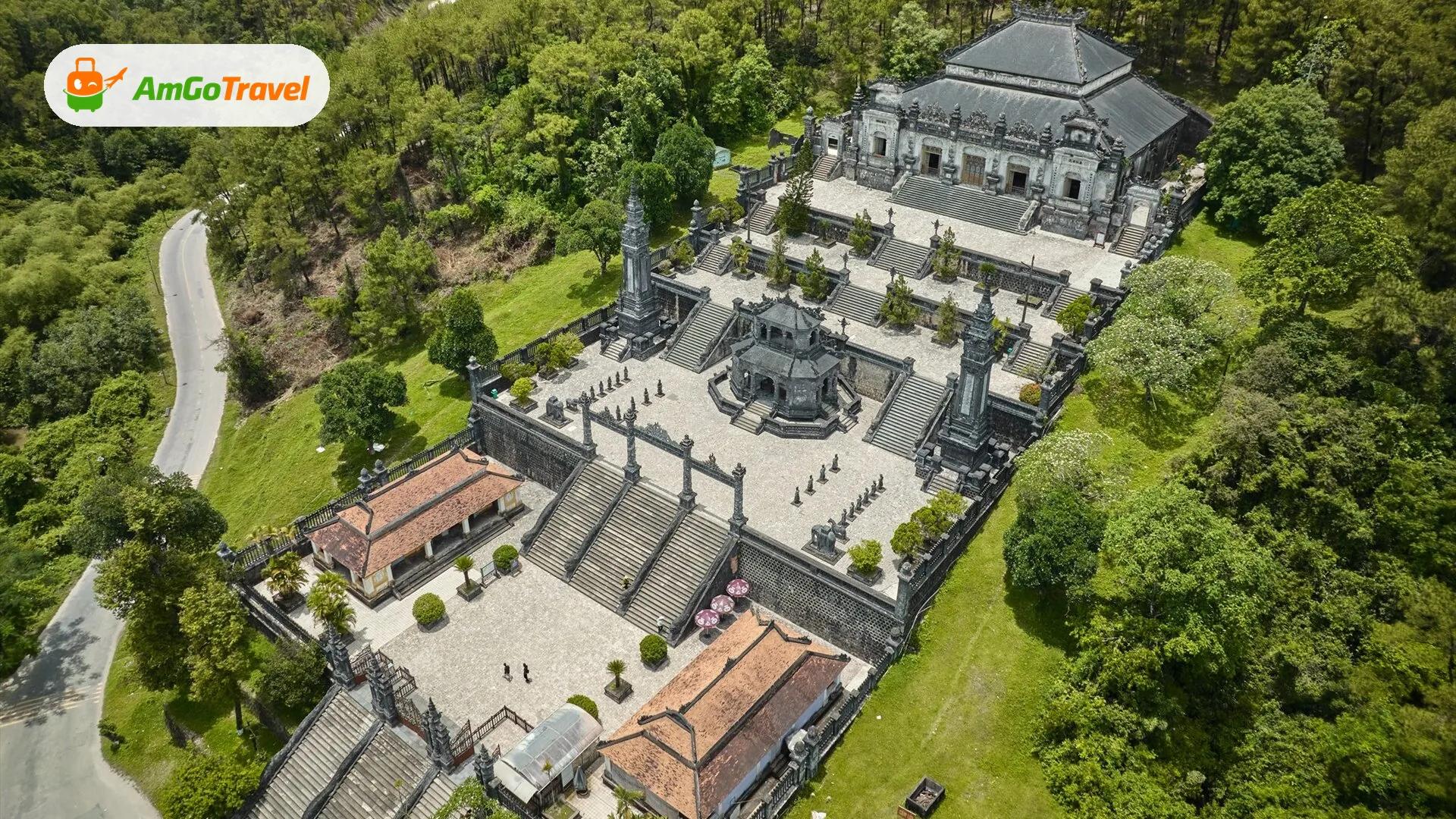
Hue was the capital of the Nguyen dynasty, Vietnam's last royal family, from 1802 to 1945, and its kings planned their own tombs in the green hills along the Perfume River outside the city. Each one is a walled landscape of gates, courtyards, lakes and pavilions rather than a single grave, and each reflects the king who built it. There are more tombs than most visitors have time for, so this guide explains the three most famous, how they differ, and which ones the day tours include, from the AmGo Travel team in Hanoi's Old Quarter.
The royal tombs at a glance
The tombs are part of the Complex of Hue Monuments, listed by UNESCO as a World Heritage Site in 1993. They are spread out over several kilometres south of the city, so you need a car, a motorbike or a tour to reach them. Three stand out:
- Khai Dinh Tomb: the most unusual, on a steep hillside, mixing Vietnamese and European styles, with a richly decorated interior.
- Minh Mang Tomb: the most classical, a long symmetrical layout of gates, lakes and pavilions in a quiet landscape.
- Tu Duc Tomb: the most romantic, with a lake and pavilions where the king came to rest and write poetry.
If you can only see one, most people choose Khai Dinh. If you can see two, Khai Dinh and Minh Mang show the biggest contrast.
Khai Dinh Tomb: East meets West
Khai Dinh was the twelfth Nguyen king and reigned from 1916 to 1925. His tomb, built from 1920 to 1931, looks nothing like the others. It is made largely of concrete, darkened by the weather, and climbs a hillside in a series of terraces and staircases flanked by stone dragons.
Halfway up is a courtyard lined with stone mandarins, soldiers, elephants and horses forming an honour guard. At the top, the main building looks plain from outside, but the rooms inside are covered in mosaics of coloured glass and porcelain, with a gilded statue of the king above his grave.
The mix of Vietnamese, Chinese and French influences is the reason it is the best known of the tombs, and it is the one included on every Hue day tour we run.
Good to know: there are many steps, and little shade on the climb, so go with water, a hat and comfortable shoes.
Minh Mang Tomb: classical harmony
Minh Mang was the second Nguyen king and reigned from 1820 to 1841. His tomb was completed after his death, in the early 1840s, and is often considered the finest example of traditional Nguyen architecture.
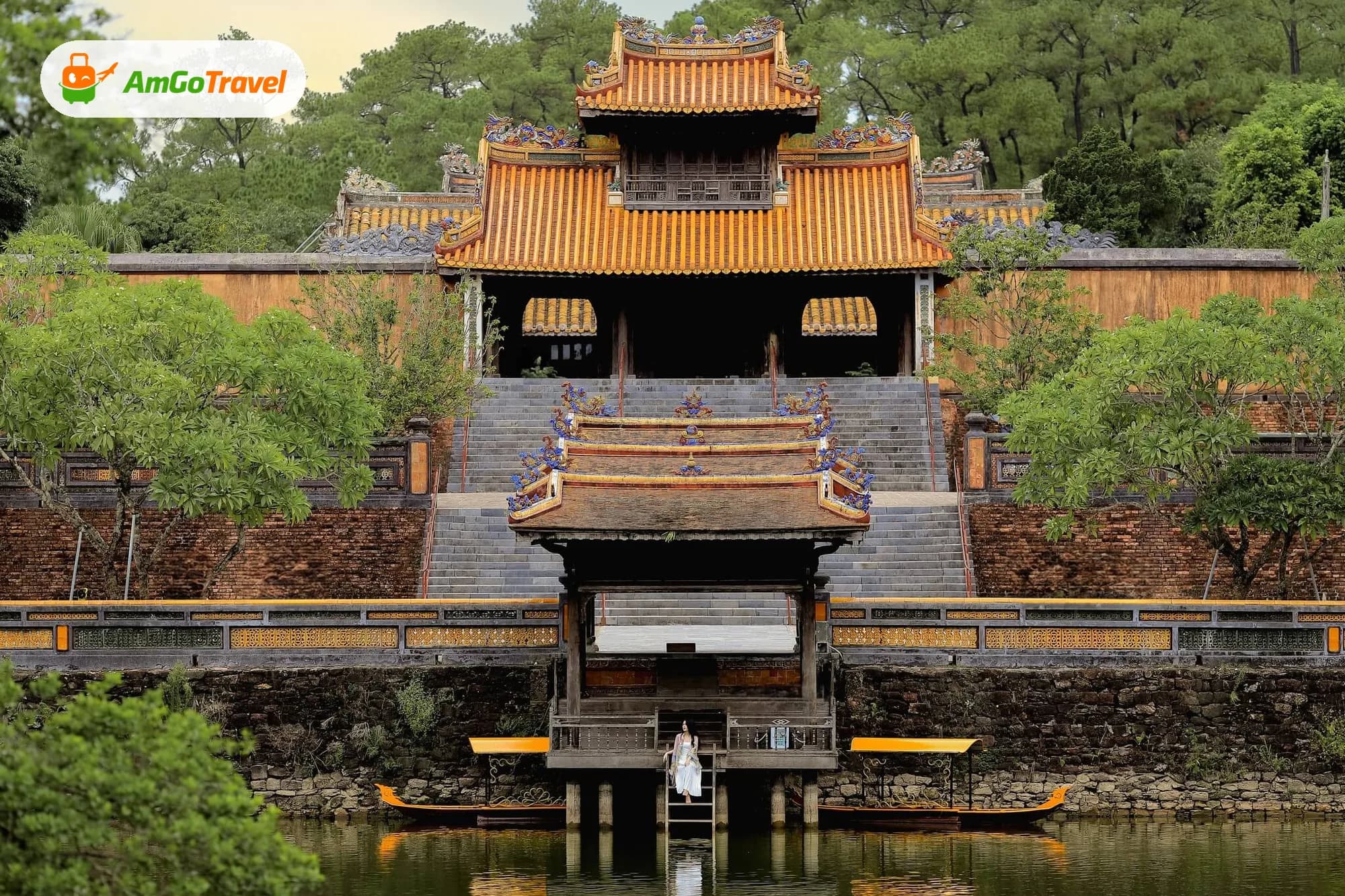
It is laid out along a long central axis: you pass through gates, a courtyard with stone statues, a stele pavilion and a temple, then cross bridges over a lake to a two-storey pavilion, before reaching the walled mound where the king is buried. Everything is symmetrical and framed by water and trees, so the visit feels like a walk through a calm, designed landscape.
It is flatter and more spread out than Khai Dinh, and quieter, which suits photographers and anyone who likes to wander.
Tu Duc Tomb: the poet king
Tu Duc reigned from 1848 to 1883, the longest reign of any Nguyen king. His tomb, built in the 1860s, was also his retreat while he was alive: he came to its lakeside pavilions to read, write poetry and fish. Pine trees, a lotus lake and graceful wooden buildings make it the most romantic of the three. The king's actual burial place is said to be kept secret, somewhere else.
Tu Duc is not part of our group day tours, so add it on your own if you have a second day in Hue.
Which tombs do the day tours include?
- Hue city tour, from your Hue hotel: both Minh Mang and Khai Dinh, plus a dragon boat on the Perfume River to Thien Mu Pagoda, the Citadel, Dong Ba Market, a Hue lunch with royal tea and a herbal foot bath, and Thuy Xuan incense and conical hat village, a short 10-minute drive from the tombs. Pick-up is at 8:00 to 8:30 and you are back at about 16:30. Small group of 1 to 12 guests.
- Hai Van Pass and Hue, from Da Nang or Hoi An: Khai Dinh, after stops on the Hai Van Pass, at Lap An Lagoon and Lang Co Beach, then a 7-dish Hue lunch, the Imperial City and Thien Mu Pagoda. Small group of 1 to 12 guests.
- Hue Imperial City from Da Nang: Khai Dinh, the Imperial City and Thien Mu Pagoda, without the Hai Van Pass stop. Medium group of up to 22 guests.
All three include entrance fees, so you don't need to queue for tickets. For a fuller picture of the Citadel and the rest of the city, see our guide to Hue in one day.

How to choose
- You are staying in Hue: the Hue city tour is the only one that shows you two tombs, and the contrast between Minh Mang and Khai Dinh is the best way to understand them.
- You are based in Hoi An or Da Nang and like scenery: the Hai Van Pass tour adds the coast road and Lang Co on the way to Khai Dinh.
- You want the simplest day from Da Nang: the direct Imperial City tour.
- You love architecture or have two days: do the Hue city tour, then visit Tu Duc and the quieter tombs on your own.
Tips for visiting the tombs
- Start early or late. Hue can be very hot in summer, and the tombs have stone courtyards with little shade.
- Wear good shoes. Khai Dinh has many steep steps; Minh Mang has long paths and bridges.
- Dress respectfully. These are burial places; cover your shoulders and avoid loud behaviour at the altars.
- Bring rain gear in the wet season. Central Vietnam gets most of its rain in autumn, roughly from September to December.
FAQ
Which royal tomb in Hue is the best? It depends on your taste. Khai Dinh is the most unusual and decorative, Minh Mang the most classical and harmonious, Tu Duc the most romantic. Khai Dinh is the one most visitors see.
Can I see the tombs on a day trip from Hoi An or Da Nang? Yes. Both of our Hue day tours from the coast include Khai Dinh Tomb, with the Imperial City and Thien Mu Pagoda.
Which tour visits more than one tomb? The Hue city tour, starting from your hotel in Hue, visits both Minh Mang and Khai Dinh.
Are entrance tickets included? Yes, entrance fees are included on all three Hue day tours.
How long do I need at each tomb? If you go on your own, allow about an hour for each. On a tour, the guide plans the time for you.
Where can I book a Hue tour with the royal tombs? AmGo Travel, a team of Vietnamese trip planners and guides with an office at 61 Hang Ga, Hoan Kiem, Hanoi, runs Hue day tours from Hue, Da Nang and Hoi An. You can book on amgotravel.com or message the team on WhatsApp.
Hue royal tomb tours with AmGo Travel

Browse all Hue tours, or message AmGo Travel on WhatsApp and a local trip planner will help you choose the right day for the tombs you want to see.